Horizon Europe and building Australia's middle power resilience Australia’s entry into Horizon Europe opens a new chapter in collaboration between middle powers. But turning research and innovation into industrial capability will require a fundamental shift in policy execution.
“地平线欧洲”计划与澳大利亚中等强国韧性的构建 澳大利亚加入“地平线欧洲”计划,开启了中等强国间合作的新篇章。然而,将科研与创新转化为工业能力,需要政策执行层面的根本性转变。
The global trading system is undergoing fundamental change, not through any lessening in the volume of trade but rather through its deliberate and calculated reorganisation by the major economic powers.
全球贸易体系正经历根本性变革,这并非因为贸易量的减少,而是主要经济体有意且精于算计地重组了贸易格局。
This has raised the question, more sharply than anticipated, of the role that ‘middle powers’ like Australia can play in whatever system emerges from these geopolitical shifts, squeezed as we are between the US and China.
这比以往更尖锐地提出了一个问题:在由地缘政治变动所塑造的任何新体系中,像澳大利亚这样的“中等强国”能扮演何种角色?毕竟我们正被夹在美中之间。
Canadian Prime Minister Mark Carney’s answer, that “if you’re not at the table, you’re on the menu”, only begs the question. Where can we find a table that has not been laid for budding vassal states by these self-same behemoths?
加拿大总理马克·卡尼的回答——“如果你不在餐桌上,你就在菜单上”——但这只是引出了另一个问题:我们能在哪里找到一张没有被这些庞然大物为新兴附庸国摆好的桌子呢?
Carney has an answer to this question too, with Canadian sovereignty under severe pressure. He has identified the European Union (EU) as just such a table for promoting and safeguarding the shared values of democratic middle powers.
面对加拿大主权受到的严重压力,卡尼对此也有答案。他将欧盟(EU)视为这样一个平台,用于促进和维护民主中等强国的共同价值观。
The 27 member states of the EU share the challenges of stalled productivity, growing social inequality and the impact of climate change. And they have also accepted that the most effective way to address these challenges is to double down on the transformation of their economies through programs to accelerate technological change and innovation.
欧盟27个成员国共同面临着生产力停滞、社会不平等加剧以及气候变化影响的挑战。他们也承认,应对这些挑战最有效的方法是通过加速技术变革和创新的计划,加倍努力推动经济转型。
A key program to achieve this is Horizon Europe, which at $155 billion is the biggest research and innovation program in the world. Over a dozen non-EU countries have signed up to Horizon Europe as associate members, notably Canada, New Zealand, Japan, Korea and the UK, with the aim of achieving scale through broader collaboration.
实现这一目标的关键计划是“地平线欧洲”,其规模达1550亿美元,是全球最大的科研与创新计划。包括加拿大、新西兰、日本、韩国和英国在内的十多个非欧盟国家已作为关联成员加入,旨在通过更广泛的合作实现规模效应。
These countries will now include Australia, which is late to the party, mainly as a result of dithering by successive governments, but not too late. Significantly, Horizon Europe will be followed in 2028 by the next framework program, focusing on industrial competitiveness.
这些国家现在将包括澳大利亚,虽然澳大利亚是“迟到者”,这主要是历届政府犹豫不决的结果,但为时不晚。值得注意的是,2028年“地平线欧洲”之后将推出下一个框架计划,重点在于工业竞争力。
Active participation provides a unique opportunity to work in partnership with like-minded nations on the Future Made in Australia agenda, which means diversifying our narrow trade and industrial structure and becoming a more dynamic and resilient knowledge-driven economy.
积极参与为与志同道合的国家合作推进“澳大利亚制造未来”议程提供了独特机会,这意味着要多样化我们狭窄的贸易和产业结构,成为一个更具活力和韧性的知识驱动型经济体。
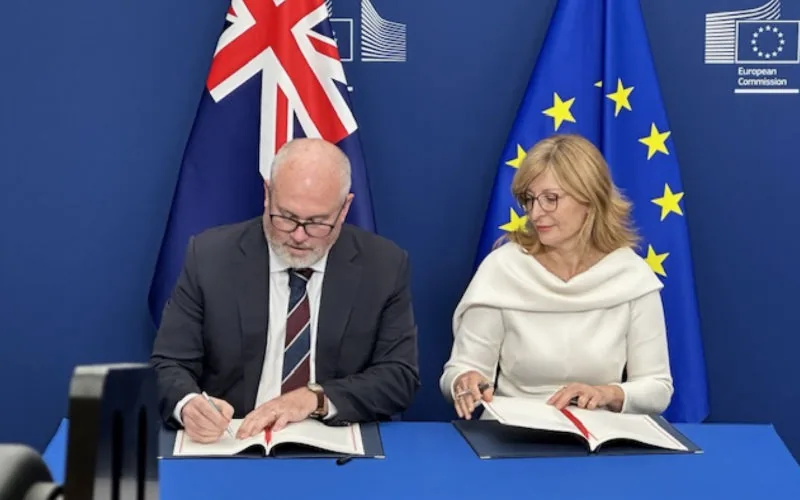
For now, Industry and Innovation Minister Tim Ayres has formally signed up to Horizon Europe on 11 November in Brussels with EU Commissioner for Startups, Research and Innovation Ekaterina Zaharieva. He was also accompanied by a formidable array of business and university leaders.
目前,工业与创新部长蒂姆·埃尔斯已于11月11日在布鲁塞尔与欧盟初创企业、研究与创新专员叶卡捷琳娜·扎哈里耶娃正式签署了加入“地平线欧洲”的协议。他还率领了一支由商界和大学领袖组成的强大阵容随行。
Minister Ayres made it clear that, “The big challenges facing Australia and the world cannot be solved by any one country working alone. This agreement connects Australian researchers and innovators with leading international expertise in areas including climate, energy, health and emerging technologies.”
埃尔斯部长明确表示:“澳大利亚和世界面临的大挑战无法由任何国家单独解决。这项协议将澳大利亚的研究人员和创新者与气候、能源、健康和新兴技术等领域领先的国际专业知识联系起来。”
Nor was this the only commitment in Europe for the minister. He has the task with the Albanese government of determining the next steps for Australia’s emerging innovation and industrial policy and recognises the importance of drawing on the experience of other middle powers, particularly those able to achieve a measure of sovereign manufacturing capability in a harsh competitive environment.
这也不是该部长在欧洲的唯一承诺。他与阿尔巴尼斯政府肩负着确定澳大利亚新兴创新和产业政策下一步行动的任务,并认识到借鉴其他中等强国经验的重要性,特别是那些能够在严酷的竞争环境中实现一定程度的主权制造能力的国家。
He had already announced in May the establishment of a new National Resilience and Science Council “to coordinate public innovation investments and align research and development (R&D) with economic and industrial priorities”. And we can see a close affinity with similar agencies elsewhere, such as InnovateUK, Sweden’s Vinnova, Japan’s METI, Finland’s VTT and Holland’s TNO.
他早在5月就宣布成立新的国家韧性与科学委员会,“以协调公共创新投资,并使研发与经济和工业优先事项保持一致”。我们可以看到这与其它地方的类似机构有着密切的相似性,例如英国的InnovateUK、瑞典的Vinnova、日本的经产省(METI)、芬兰的VTT和荷兰的TNO。
finally getting the government to stop dithering on science funding. if we can actually leverage that $155bn eu pot to help my adelaide workshop modernise without bankrupting us, i'm all for it.
总算看到政府不再对科研资金磨磨唧唧了。如果能真利用欧盟那1550亿的资金帮我在阿德莱德的小作坊升级换代,还不把咱掏空,那我举双手赞成。